The Demise of Anita & Bell Punch
Rockwell had bought Sumlock Anita Electronics in 1973. Its range of calculators under the ANITA, Unicom, and Rockwell names was very successful, but these were a very small part of a large high-technology company. As the prices of calculators plummeted in the mid-1970s, and the profit too, Rockwell lost interest in them.
John Sparkes relates:
"At first it appeared that Rockwell International would support Sumlock Anita and use our strong team of
design, manufacturing and marketing personnel to diversify into other types of office equipment, such as word processors. All the indications were that we would become an integral part of Rockwell. Being such a large
organisation meant that they were very conscious of their Corporate 'image' and I received several large volumes dealing solely with this subject. Every aspect of our company administration had to conform to their
stringent requirements.
John Sparkes placed a recruitment advertisement in the technical press in May 1974, at a time when he thought the future with Rockwell International was assured[1]:
Sumlock Anita
Rockwell International
The R & D Department of Sumlock Anita Electronics Limited, a member of the Rockwell International Organisation are engaged in the Design, Development and Manufacture of Electronic Calculators, Billing/Accounting Equipment, Computer Peripherals and Test Equipment. Planned expansion of our activities has created the following interesting and rewarding opportunities.
Electronic Design Engineers
Electronic Engineers with experience of logic and circuit designs on digital systems, computer
peripherals, or power supplies are required to join our existing design team. Applicants must have been involved in recent development projects and have the ability to resolve design concepts within a specified time
scale. Senior Engineers must be of graduate level and have a good knowledge of MSI/LSI integrated circuits.
Systems Engineers
Engineers required for the design and development of micro-processor based computing systems. This
work involves developing micro-program software for the control of complex hardware devices together with the design of the logic interfaces.
Test Equipment Engineers Technical Assistants
Senior and Junior Engineers and Technical Assistants for the design and
development of computer aided digital test equipment. Very interesting projects involve the use of electronic, opto-electronic, mechanical and pneumatic techniques. Applicants for Technical Assistant should have a
background of electro-mechanical assembly and prototype wiring.
Section Leader Printed Circuit Design
To take charge of a section producing single, double-sided and T.H.P. layouts and artwork. Applicants should be
experienced in layout of high density circuits together with up-to-date production, plating and inter-connection techniques. This post is of exceptional interest to a P.C. Designer who wishes to assist in exploring computer
aided design procedures.
Group Leader Mechanisms Development
We require an experienced man to lead a team developing mechanisms and computer
peripherals for our Business Systems activities. He will probably have a good engineering degree and be experienced in designing intricate-but-reliable electro-mechanical equipment for high volume production. We would
expect him to have a knowledge of servo-mechanism design and be capable of performing theoretical analyses of mechanical systems.
The opportunities to join an enthusiastic team offer pleasant working conditions, generous negotiable salaries and excellent fringe benefits.
The Company is situated on the outskirts of UXBRIDGE
overlooking open countryside within walking distance of shops and public transport.
Please phone or write to:— Mr. J. M. SPARKES. TECHNICAL MANAGER, SUMLOCK ANITA ELECTRONICS LTD., THE ISLAND, UXBRIDGE, MIDDLESEX. TEL: UXB
51255 EXT.240.
As late as 1975 the journal Wireless World carried job advertisements for Sumlock Anita Ltd.:
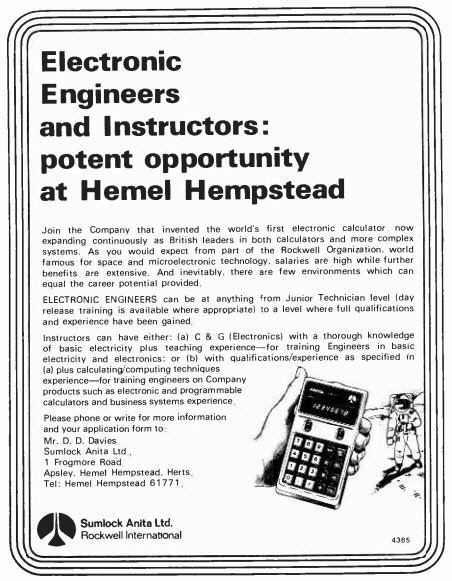
The advertisements above indicate the exciting areas of development that Sumlock Anita was moving in.
John Meade confirms one of the developments of that period:
"I had been employed with Sumlock as a field service engineer in the Central London Area working on the full calculator
range from the Mark 8 to the 1011 LSI. My final years had been spent as an engineer working on the ABC, the Anita Business Computer, which was a full accounting computer
built in to a desk unit using the electronic keyboard and display unit from the 1011 LSI and a full electronic typewriter by Triumph Adler."
But John Sparkes continues:
"Slowly but surely the signs began to appear that they were losing interest in their commercial ventures, and in retrospect, it coincided with their
re-entry into the American Space programme by gaining the contract for the Space Shuttle. Admiral, the American television manufacturing company they had acquired, was sold off, and as far as we were concerned the writing was
on the wall. Rockwell began concentrating on Unicom calculators rather than ours, and as the competition increased they looked farther afield for cheaper production costs. First to Puerto Rico, and then to the Far East,
but it was all in vain and it soon became obvious that whatever assets Sumlock Anita represented were to be liquidated. A team of Rockwell executives arrived to look at our organisation and make the necessary decisions, and I
was heavily involved in providing them with product information in order that they could assess the worth of patents, tooling, parts, etc.
The outcome of this was that an electronics company was founded in Niš, Yugoslavia, which was interested in buying both the design and the production facilities of our hand-held calculators [see the "Models Derived from ANITA" section of this site]. This included all drawings, parts lists, production tooling at our Portsmouth factory, and our recently set up plastic moulding facility in East Kilbride in Scotland. The most heartbreaking aspect of the whole Rockwell saga now began. Virtually every week a number of staff were made redundant until we closed down altogether. We had been a comparatively happy team that had been welded together over many years and for everyone to be so coldly dismissed was very traumatic."
An article in the Computer Weekly dated 22 January 1976 described the fate of ANITA, Norbert Kitz, John Sparkes, and the Research and Design team[2]:
"Rockwell closes Anita factory
A rapid increase in the cost of calculator production in the UK is claimed to be the reason for the closure of the
historic Portsmouth factory of Sumlock Anita, a company owned by Rockwell International.
Now considered little more than a nuisance, the factory is in reality a monument to British inventiveness, for it was
here that the world's first electronic calculator, the Anita Seven, was invented and manufactured.
The invention fired the imagination of electronic wizards from Tokyo to Detroit, but since 1973 Rockwell
International, the parent company of Sumlock Anita, has stripped the company of its identity.
Five years ago Sumlock Comptometer, as it was then called, employed a staff of more than 1,400, but by the middle
of this year the figure will have dropped to 650. Among those to go are the research and design team responsible for the first Anita, Kitz and Sparkes. Indeed, the entire research and design team has been disbanded
since Rockwell have facilities in the US for this purpose. Another reason for the dramatic decline in staff is the alteration of the sales structure from being a direct sales organisation to being a dealer
oriented organisation, selling through retail outlets and agents. The closure of the Portsmouth factory means that 220 employees will be made redundant, and the name of Sumlock Anita can now only be linked to an
organisation marketing and servicing Rockwell International calculators manufactured in Japan."
This had a dramatic effect on Sumlock Anita, as John Lloyd explains: "In 1975 Rockwell got the contract for the Space Shuttle and lost interest in foreign commercial spin offs. It sold all the assets to various buyers. The name Sumlock Anita was sold to a trading company [Fi-cord International Ltd.] which sold off the existing stock and then badged various imported products [See the ANITA 8011, ANITA 8041 and ANITA 1211] until the name finally lost its selling power.
Control Systems Ltd. [the original parent company] and the remainder of the Bell Punch Company had not been sold to Rockwell and continued with its traditional products — ticket printing, ticket issuing machines, coin machines, totalisators, and taximeters — from its headquarters site in Uxbridge, and its factories in Herne Bay, Canterbury, and Glasgow.
Norbert Kitz stayed with Bell Punch for another year and left to become an independent consultant. I stayed with the company until it was broken up in 1986 and asset-stripped, and I was made redundant".
So a glorious company came to an end...
...though vestiges of Sumlock Anita and Bell Punch lingered on...
The ex-Sumlock-Anita sales offices and service offices were then offered as franchises to those who worked in them.
John Meade explains: "I worked for
Sumlock Comptometer, then Sumlock Anita, then Rockwell International from about 1968 up until Rockwell pulled the plug and closed down its UK operation. At that time Rockwell was keen to fulfil its outstanding contractual
maintenance commitments and offered franchises to all of its maintenance offices to allow them to continue to support its customer base. I was one of a team that won the franchise for the City of London area and started a new
Company called Anita Electronic Services Ltd. Most of the franchises made every effort to use either the Sumlock or the Anita (or both) name in their new Company names."
Mike Denman was a service engineer with Sumlock-Anita at the Finchley branch and relates: "The end came in July 1976 when we heard that everyone was to be made redundant. I remember it well because I was on maternity leave and my eldest son was one week old. The unions were intent on fighting the closure, but the offer of franchises to the service engineers pulled the rug from under them. As far as I remember, nearly every service branch put a franchise proposal to the Anita Board and I remember meeting Mr. R. Walter at Anita House, Uxbridge, to be granted ours. The one page franchise agreement was very basic, it simply stated which branch we were and the area we were being allocated. It also included the fact that we were not allowed to sell as this would compete with the Sumlock Sales franchises.
Our franchise, Electronic & General Services Ltd., consisted of five engineers, who mainly worked on business systems; Roger Hammond, Bill Daniels, Derek Capes, Izzet Coshkouner and myself Mike Denman. It wasn't long before we moved from Finchley to Hoddesdon, where we found cheaper workshop space. But we knew that if we were to survive, we would have to diversify and also sell whatever we could, despite the 'ban'. We were probably the first franchise to openly break 'the rules' but it was a case of survival.
Technology was moving at quite a pace in the late '70's and in 1978 we became one of the first Commodore agents in the country. We then went on to sell IBM PC's. Our big break, however, came in 1980 when an American company asked us to install a POS system for them, in a burger restaurant in Cambridge. We had been recommended by Sumlock's Scottish franchisee, Scotia Office Equipment, because we provided Scotia with panel repair facilities for the ABC and the Farringdon 1010. We then went on to install systems in many fast food chains."
It seems that a number of these franchises were successful and continue in business to the present day. Some are listed in the 'Continuing Companies' section of this site.
Some calculator manufacturing under the ANITA name also continued, but in not in Britain. Fi-cord International Ltd, of Didsbury, Manchester, which had been a distributor of the ANITA hand-held calculators, obtained the right to the ANITA name which was used on models manufactured in Yugoslavia, to where designs and tooling had been sold. This lasted at least into 1977 — see the ANITA 8011, ANITA 8041 and ANITA 1211.
John Clements
was employed as an engineer by Sumlock from 1958 till 1978. He started in the Clerkenwell Road office, before transfering to the Ealing office at Hanger Lane, and then on to the Norwich service depot.
He relates: "When Rockwell took over it was the death of Sumlock and pretty soon the 33 nationwide service depots were bought out as management buy-outs, and went independent, servicing other make of calculators. The Norwich office became Sumlock Bondain, which is still in business, and turned to computers, mainly the Commodore PET."
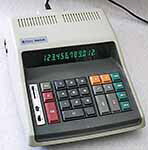
Sumlock Bondain 320A desktop calculator
In 1978 Practical Computing journal reported on a Sumlock Bondain shop inside Cannon Street Station in London which was just starting to market the Commodore Pet personal computer[3]:
"The shop is run by Sumlock-Bondain, a company with its roots in the Sumlock-Anita calculator business. It was formed by people made redundant by the takeover
of Sumlock-Anita by the U.S. giant Rockwell, who did not want to see their talents go to waste and decided to continue in that same business.
Originally they sold the Sumlock calculator range but when that was
wound up by Rockwell, they found favour with Texas Instruments, for whom they are wholesalers, and with Hewlett-Packard, for whom they act as a main agent.
...
The only computer system on
show at the shop at the moment is the Pet; the remainder of the space is occupied by calculators. The company also supplies the Adler TA20 system, and the Compucorp 625 series.
...
... According to shop manager Mike Kick: "After the Christmas rush, in which we expect to sell plenty of calculators, more space will be given to computer systems".
...
... An added
advantage is that Sumlock-Bondain has a sister organisation—Anita Electronic Services (London)—which specialises in servicing and maintenance.
...
As to the future, White and
Kick see only growth and expansion. "We shall be opening a new shop in Norwich very shortly", says White, "and there will be more in London, too"."
The Bell Punch Company
Adrian Wheeler, Finance Director & Company Secretary of Metric Group Limited,
kindly provided the following information about the fortunes of the Bell Punch Company:
"After the sale of Sumlock Anita and the calculator interests to Rockwell in 1973 the Bell Punch Company continued to manufacture its
other products, including ticketing machines and their tickets, and taximeters.
Bell Punch ceased to be used as a trading entity after Control Systems Ltd (as based at the Island at Uxbridge) was sold off by the Yard Group to the Incentive Group (Swedish Group) in the early 1980's. The Incentive Group already owned an established transport ticketing business called Almex, amongst other businesses, and they decided to create a ticketing based business by putting Almex and Control Systems together, creating Almex Control Systems Ltd, which focused on bus ticketing and car park ticketing. Almex already had the ability to manufacture all components in-house and so the Incentive Group broke up Bell Punch and sold off the duplicate capabilities.
Incentive Group then rebranded the ticketing division Metric and sold off the non Scandinavian element, which has changed hands a few times in the last 15 years and is currently owned by a German PLC called Hoeft & Wessel, which is into Bus and Rail ticketing as well as Airline booking-in systems and retail and logistic tracking technology.
Metric Group Ltd can thus trace a root to the Original Bell Punch Company and holds the certificate of incorporation of the company signed in July 1878. The Bell Punch Company and Control Systems Ltd still remain as listed UK companies today, albeit dormant."
See also https://www.metricgroup.co.uk/company-history/.
Post script
Only a small number of companies in the calculator business survived the plummeting prices of the mid-1970s. These include
Casio, Sharp, and Texas Instruments, which had huge world-wide sales of quality calculators, and could survive on a small profit from hundreds of thousands of machines sold. Hewlett Packard survived in the calculator market
by selling smaller quantities of high-quality, highly specified machines, which had a larger profit margin.
Most other companies of medium size, or without huge world-wide sales, could not make sufficient profits in the cut-throat calculator business of the late 1970s. These included such innovative companies as Bowmar, Busicom, Rapid Data, and Sinclair. So it was almost inevitable that Sumlock Anita would go out of business.
Reference:
The Bell Punch Company & the Development of the Anita Calculator
< Previous page Next page >
Text & photographs copyright © 2002 - 2023 Nigel Tout, except where noted otherwise.